Does Ozempic Really Melt Your Muscles? What the Science Says
Headlines claim GLP-1 medications cause your muscles to "melt away," but the research tells a more nuanced story. Here's what the evidence actually shows, and what you can do about it.


You've probably seen headlines or social media posts saying that GLP-1 medications like Ozempic, Wegovy, or Zepbound cause your muscles to waste away. You've probably also been told that hitting the gym is the only way to avoid withering away. Is that true?
According to the latest research, the real answer is somewhere in between. And the good news is that the real solution works whether or not you're taking GLP-1 medications.
What Do the Studies Show?
During large clinical trials, researchers used body scans to track body composition along with weight loss for both semaglutide and tirzepatide users. The scans are able to identify the difference between fat, muscle, organs, and bones.
The trials found that up to 40 percent of total weight loss came from "lean body mass," meaning that the majority of weight loss was fat (Neeland et al., 2024; Look et al., 2025).
That may sound alarming, because people often confuse "lean body mass" with "muscle mass," but they aren't the same.
Lean Body Mass Is Not the Same as Muscle Mass
Both terms are often used interchangeably in headlines and on social media, and researchers have been clear that they shouldn't be (Baglietto et al., 2024, Frontiers in Nutrition).
- Lean body mass is everything in your body that isn't fat: that includes organs, bones, water, connective tissue, and yes, muscle.
- Skeletal muscle mass is only muscle.
So when a headline says "40 percent of the weight lost was lean mass," that figure includes water, organ tissue, and bone minerals as well as muscle. In other words: the amount of actual muscle lost is smaller than the headline number suggests.
And there's something else that the headlines miss. In the body-composition analysis for the STEP 1 trial, people on semaglutide ended the study with a higher proportion of lean body mass relative to fat than when they started. How can that be? The fat loss dramatically outpaced everything else, meaning that the muscle-to-fat ratio of participants' bodies improved overall.
This Isn't Just a GLP-1 Phenomenon
Up to now, I've focused on weight loss related to GLP-1 medication usage, but the truth is that losing some lean mass is a normal part of any calorie-restricted weight loss, including diet-only approaches (Mass General Brigham clinical review).
There are several reasons for this. First, lower weight means that bones have to support less mass, so they don't need to be as dense. The same goes for organs. And you probably learned in school that 70 percent of your body is water, and a smaller body means less water.
So these new medications didn't create this issue, they just made a lot more people aware of it.
So Does Weight Training Help?
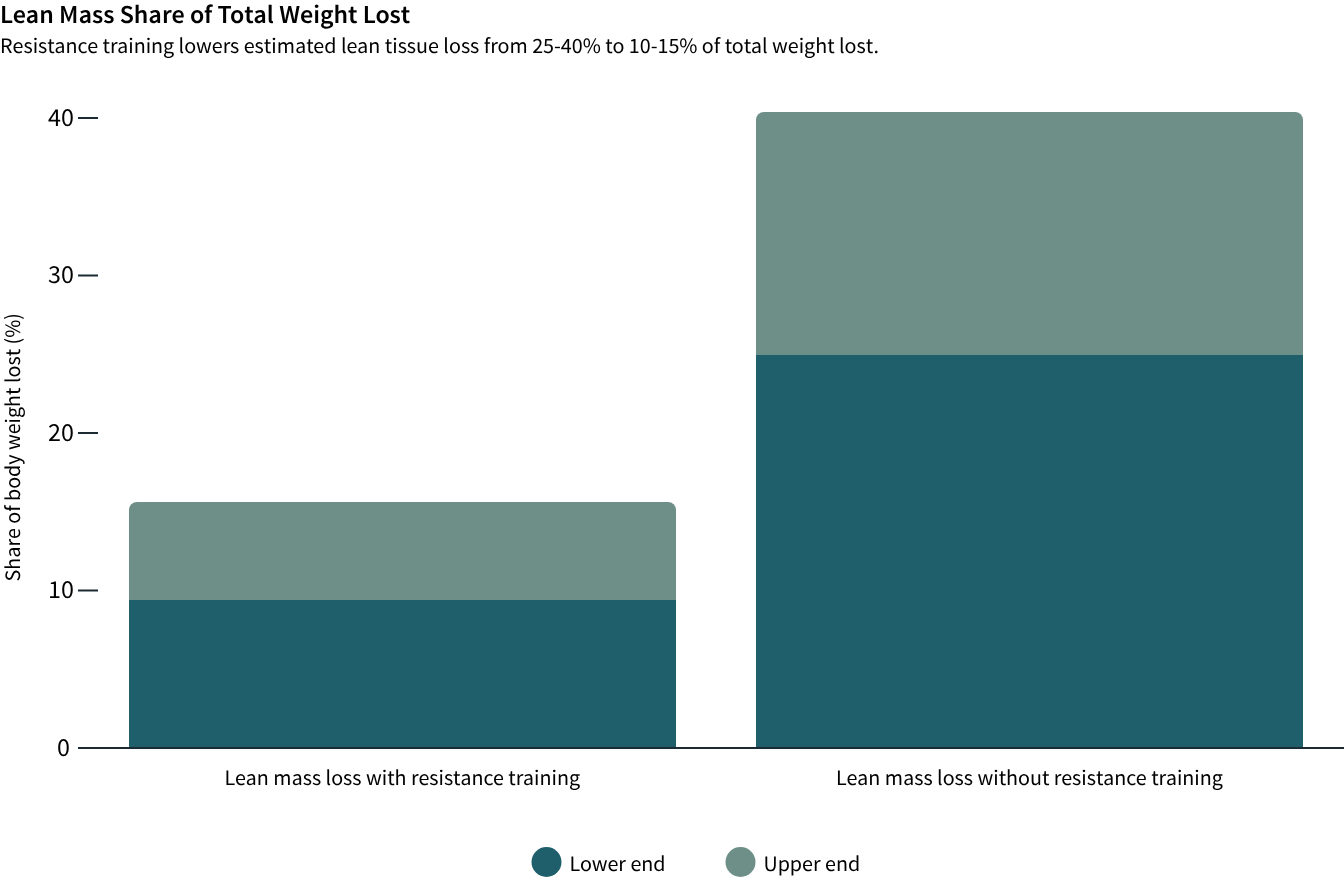
Resistance training really is one of the best tools for protecting muscle during weight loss; the consensus is that it can reduce lean tissue loss from around 25 percent of weight lost to roughly 10–15 percent. And increased protein intake can help as well (Mayo Clinic; Mass General Brigham).
But "reduce" and "prevent" are not the same thing. Exercise is a powerful buffer, not a force field. Anyone promising zero muscle loss is overselling.
All Movement Counts, Regardless of Medication
The strongest evidence for combining exercise with GLP-1 treatment comes from Danish researchers who ran randomized trials pairing a GLP-1 medication with structured exercise. Combining the two beat medication alone for fat loss and bone health. Not only that, they found that exercise was key to keeping the weight off after treatment ended (Lundgren et al., NEJM 2021; Jensen et al., JAMA Network Open 2024).
It's clear that exercise is good for you whether or not you're taking weight loss medications; the World Health Organization recommends at least 150 minutes of moderate exercise per week. A mix of activity types is the best approach:
- Aerobic exercise such as brisk walking, swimming, or cycling protects your heart and lungs. Target at least 150 minutes per week. If you struggle to reach 150 minutes, check out my article on easy ways to work movement into your daily routine.
- Resistance training can include weights, resistance bands, and body weight moves and protects muscle and bone. Shoot for at least two days per week, working all the major muscle groups.
- Balance and flexibility work helps keep you steady and mobile throughout your daily activities and can help reduce the risk of falls. Balance and flexibility includes standing on one foot, tai chi, and yoga (Canadian 24-Hour Movement Guidelines; WHO 2020).
None of these requires a gym membership or a hardcore training plan. Taking a walk with a coworker every day at lunch, a couple of strength sessions using soup cans or resistance bands at home, and a few minutes of stretching go a long way toward better health.
The Takeaway
Should you strength train while taking a GLP-1 medication? Absolutely. Will it prevent lean tissue loss? No, but that's OK. Some change in lean mass is a normal part of losing weight, no matter how you go about it. And remember that you're losing less actual muscle than headlines imply.
No matter what, a well-rounded exercise routine is your best protection regardless of what's in (or not in) your medicine cabinet.
Move often. Lift sometimes. Eat enough protein. And take viral claims about your muscles dissolving with a grain of salt.
Sources
- Neeland IJ et al. (2024). Changes in lean body mass with GLP-1 receptor agonists. Diabetes, Obesity and Metabolism.
- Look M et al. (2025). Body composition changes during weight reduction with tirzepatide. Diabetes, Obesity and Metabolism.
- Impact of semaglutide on body composition in adults with overweight or obesity: exploratory analysis of the STEP 1 study (DEXA substudy).
- Baglietto N et al. (2024). Assessing skeletal muscle mass and lean body mass. Frontiers in Nutrition.
- Lundgren JR et al. (2021). Healthy weight loss maintenance with exercise, liraglutide, or both combined. New England Journal of Medicine. Jensen SBK et al. (2024). Bone health follow-up. JAMA Network Open.
- World Health Organization (2020). Guidelines on Physical Activity and Sedentary Behaviour.
- Canadian Society for Exercise Physiology, 24-Hour Movement Guidelines for Adults.
- Mass General Brigham, "Preserving Lean Body Mass in Patients Taking GLP-1 for Weight Loss." Mayo Clinic, "GLP-1 Medications and Muscle Loss."